
Casting and Care Instructions
-Rune Casting-
This refined guide covers two distinct methods: the Three-Cast Elimination for a more ritualistic, "fated" reading, and the Direct Bag Pull for a focused, traditional interpretation.
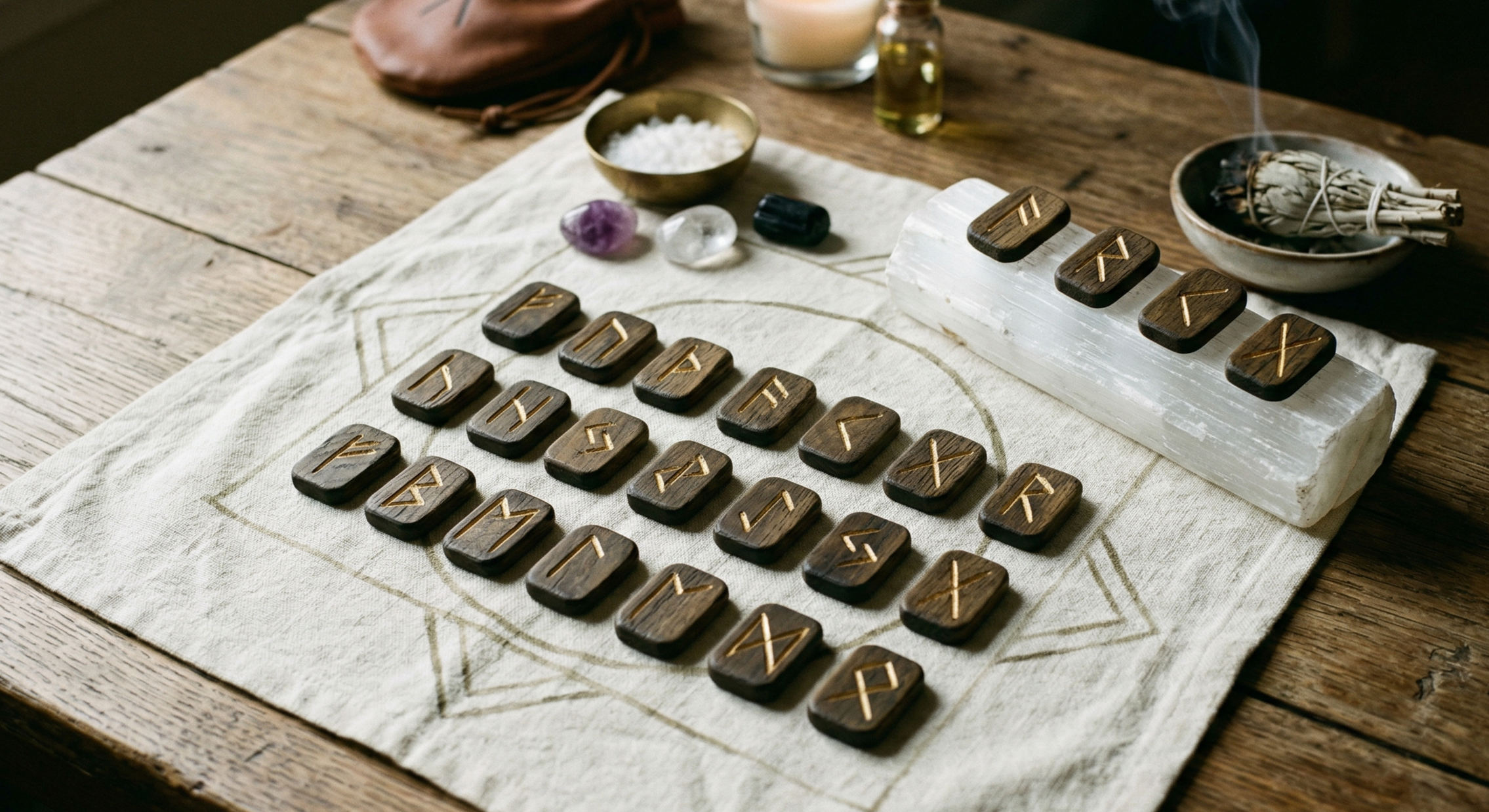
I. Preparation & Cleansing
Before you begin, ensure your tools are energetically aligned and your space is set.
Set the Foundation: Lay out a casting cloth (typically linen or wool) or a wooden tray. This defines the boundaries of your reading and keeps the runes contained.
Clear the Energy: If your runes feel "heavy" or you haven't used them in a while, cleanse them using one of these traditional methods:
Smoke: Pass the runes through the smoke of dried Sage or Palo Santo.
Earth/Crystals: Place your rune pouch on a slab of Selenite or near Clear Quartz to reset their vibration.
Breath: Hold the runes in your hands and blow a sharp, focused breath into the pouch to clear stagnant energy.
II. Method 1: The Three-Cast Elimination
This method is perfect for complex situations where you want "fate" to narrow down the message.
The First Cast: Hold all the runes in your hands or pouch. Focus on your question and gently spill them onto the cloth. Remove all runes that land face-down.
The Second Cast: Gather only the face-up runes. Shake them and cast them again. Once more, remove any that land face-down.
The Final Cast: Take the remaining face-up runes and cast them a third time. Any runes that land face-up after this third round are your final message.
The Layout: Arrange the remaining runes in a single line in the exact order they landed.
The Reading: Read the runes from Right to Left.
III. Method 2: The Direct Bag Pull
This is a standard, structured method used for specific layouts (like Past/Present/Future).
Center Your Intent: Close your eyes and reach into the rune pouch. Stir the runes with your hand while focusing on your question.
The Selection: Without looking, select three runes one by one.
The Placement: Lay them out in front of you in the order you pulled them.
Rune 1 (Left): The Overview or Past.
Rune 2 (Center): The Challenge or Present.
Rune 3 (Right): The Guidance or Potential Future.
Quick Reference: Reading Your Runes
Upright
The energy is flowing clearly and positively.
Merkstave (Reversed)
The energy is blocked, hidden, or requires caution.
Empty Space
In the Three-Cast method, if no runes land face-up, the timing isn't right for an answer.
Note: If a rune lands off the cloth or tray during a cast, it is typically considered "void" and removed from that specific reading.
-Bone Casting-
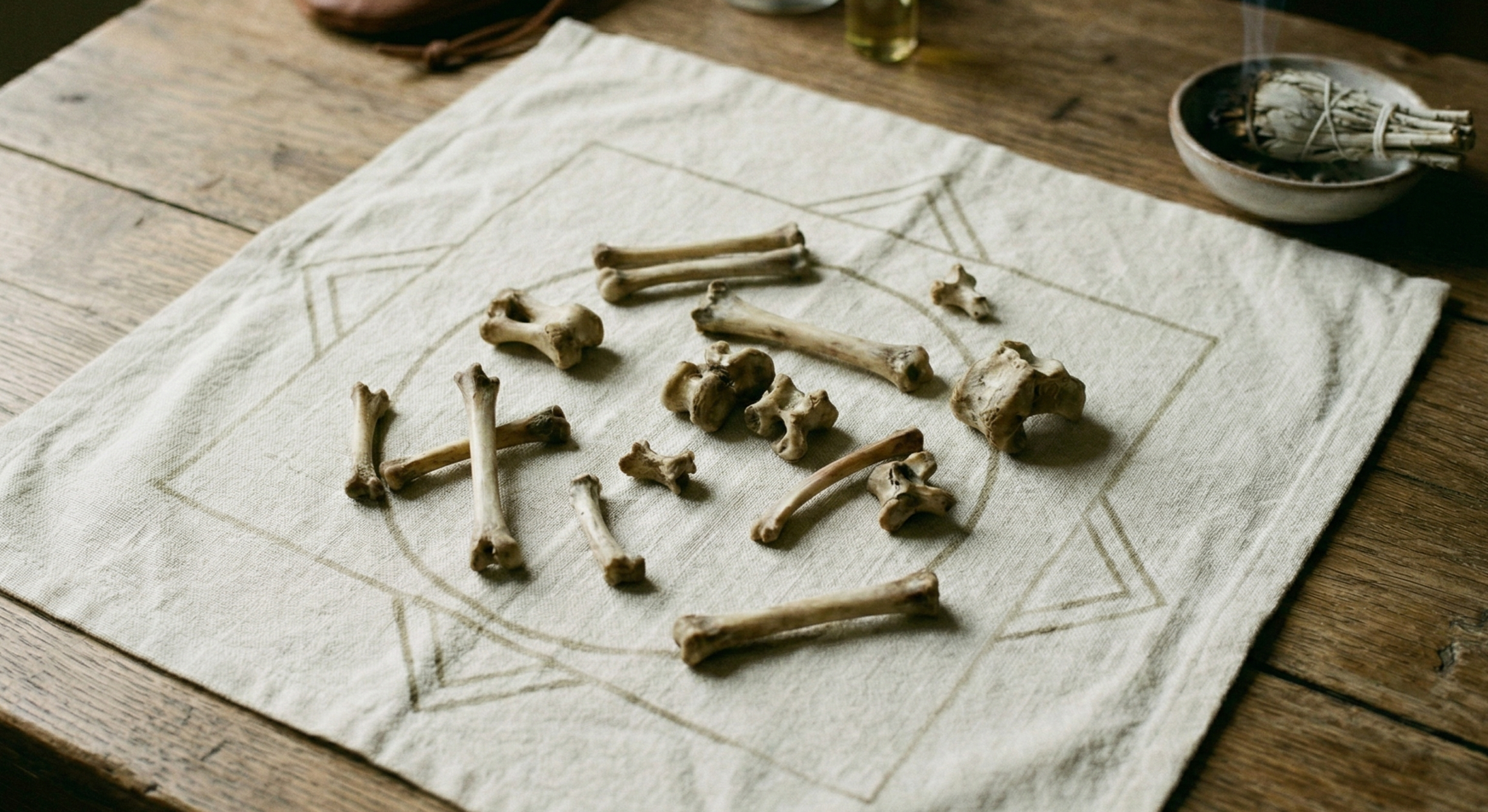
Bone casting, or Osteomancy, is one of the oldest forms of divination. Unlike runes, which rely on specific carved symbols, bone casting is an intuitive, "holistic" art. The meaning is found in the relationships between the pieces, where they land on your cloth, and the natural "spirit" of the bone itself.
I. Preparing Your Set & Space
Before casting, your bones should be treated as extensions of your own intuition and the natural world.
The Set: A traditional set typically includes a mix of "found" bones: toe bones (for travel or grounding), knuckles (for transitions or hard work), and small joints (for connections and relationships).
The Layout: Use a circular casting cloth or a shallow wooden tray. Some practitioners mark the cloth with three concentric circles:
Inner Circle: Your immediate self and home.
Middle Circle: Your community, career, and external influences.
Outer Circle/Edge: The spirit world, the distant future, or things leaving your life.
Cleansing: Since bones hold deep ancestral energy, cleanse them frequently. Pass them through mugwort smoke (for psychic sight) or bury them in a bowl of sea salt overnight to reset their "voice."
II. The Casting Ritual
Warm the Bones: Hold the pouch between your hands. Shake it gently so the bones clatter—this "wakes them up."
State Your Intent: Speak your question aloud or whisper it into the mouth of the bag.
The Throw: Reach in and grab a handful (or all) of the bones. Cast them gently but firmly onto the center of your cloth.
III. Traditional Reading Methods
In Witchcraft and Druidic traditions, we look at the "geography" of the cast rather than individual definitions.
1. Proximity and Clusters
Look for where the bones have bunched together.
The Cluster: This represents the "heart" of the matter—the area of your life where most energy is currently moving.
The Outliers: Bones that land far away from the group represent forgotten factors, distant influences, or people who are "distancing" themselves from you.
2. The Anatomy of the Piece
Since your bones have no runes, you read their physical form:
Toe Bones: Represent "footing." If a toe bone points toward you, you are on the right path. If it points away, you may be heading toward a dead end.
Knuckles: Represent "hinge points" or decisions. A knuckle landing near the center suggests a major life pivot is coming.
Joints: Represent "binding." Where two bones touch or overlap, look for a connection between two people or two ideas in your life.
3. Directional Facing
Facing Up (Hollows/Smooth sides): Indicates an "open" situation, truth being revealed, or a "yes."
Facing Down (Rough/Joint sides): Indicates a "closed" door, a secret, or a "no/not yet."
IV. The "Way" of the Bone
The Pointer: If a long bone lands pointing directly at another specific piece, the first bone is "talking" to the second. For example, a toe pointing at a knuckle suggests your current travels are leading to a major life decision.
The Crossing: If two bones land in an "X" shape, it indicates a blockage, a conflict, or a need for protection.
A Note on Ethics: In Pagan and Druidic paths, bone casting is often seen as a conversation with the Genius Loci (spirits of the land) or ancestors. Always thank the spirits of the animals whose bones you use after each session.
-Pendulum Reading-
The pendulum is a tool of ideomotor response, meaning it acts as an amplifier for your subconscious mind and your connection to the spiritual realm. Using a selection disk (or "pendulum board") provides a clear visual map for these subtle energies to communicate.
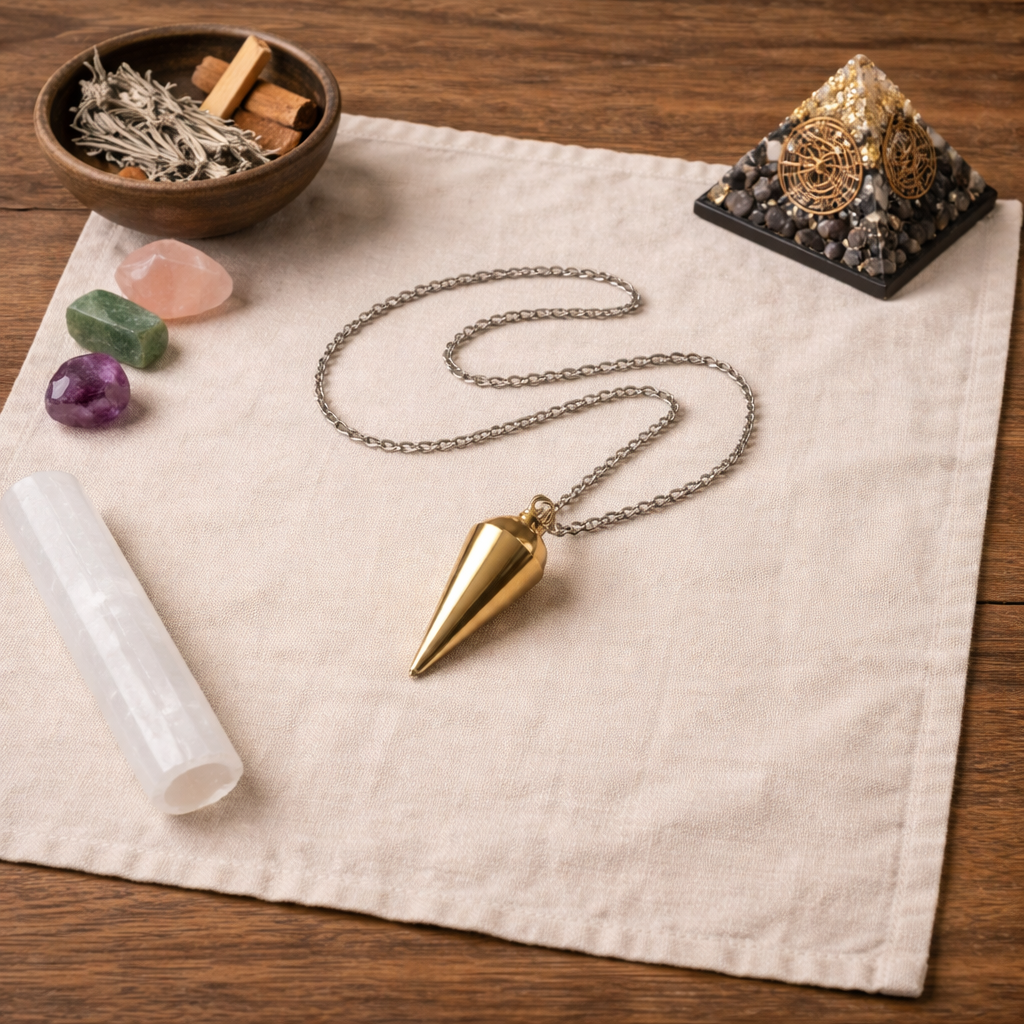
I. Calibration & Cleansing
A pendulum is a sensitive instrument that can pick up "static" from your environment or previous readings.
Physical Setup: Sit at a table with your feet flat on the floor. Place your Yes/No/Maybe/Try Again disk directly in front of you.
The Grip: Hold the fob or the end of the chain between your thumb and forefinger. Rest your elbow on the table to steady your arm, letting the pendulum hang about an inch above the center of the disk.
The Cleanse: Before asking a question, quickly "reset" the energy. You can:
Tap it: Gently tap the point of the pendulum onto a piece of Amethyst or the wooden table.
Smoke: Pass it through Sage or Palo Santo smoke.
Intent: Visualize a white light washing down the chain and out through the point.
II. Programming the "Swing"
Even with a printed disk, you must sync your energy with the pendulum to ensure accuracy.
Find Neutral: Hold the pendulum over the center point of the disk. Keep it still until it stops moving or maintains a very tiny, circular "idle" vibration.
Verify the Board: Ask a question you know the answer to (e.g., "Is my name [Name]?").
The pendulum should begin to swing along the line marked YES.
If it swings toward "No," rotate your disk to align with the pendulum’s natural movement for that session.
III. Conducting the Read
State the Question: Ask clear, closed-ended questions (questions that can be answered with the options on your disk). Avoid "Should I..." and instead use "Is it in my best interest to..."
The Release: Lower your expectations and "let go" of the answer you want. Watch the point of the pendulum as it gains momentum.
The Response:
Strong Swing: A clear, wide arc indicates a confident answer.
Circular Motion: If it circles over a specific word, that is your answer.
Trembling/Shivering: If it vibrates but doesn't swing, the energy is unclear or the question is poorly phrased.
Pro Tip: If the pendulum starts swinging in wild, erratic circles or hits the disk, it’s a sign of interference or exhaustion. Take a break, ground yourself, and try again later.